Calcium Propionate in Yeast-Raised Bread: How to Control Mold Without Losing Proof Volume
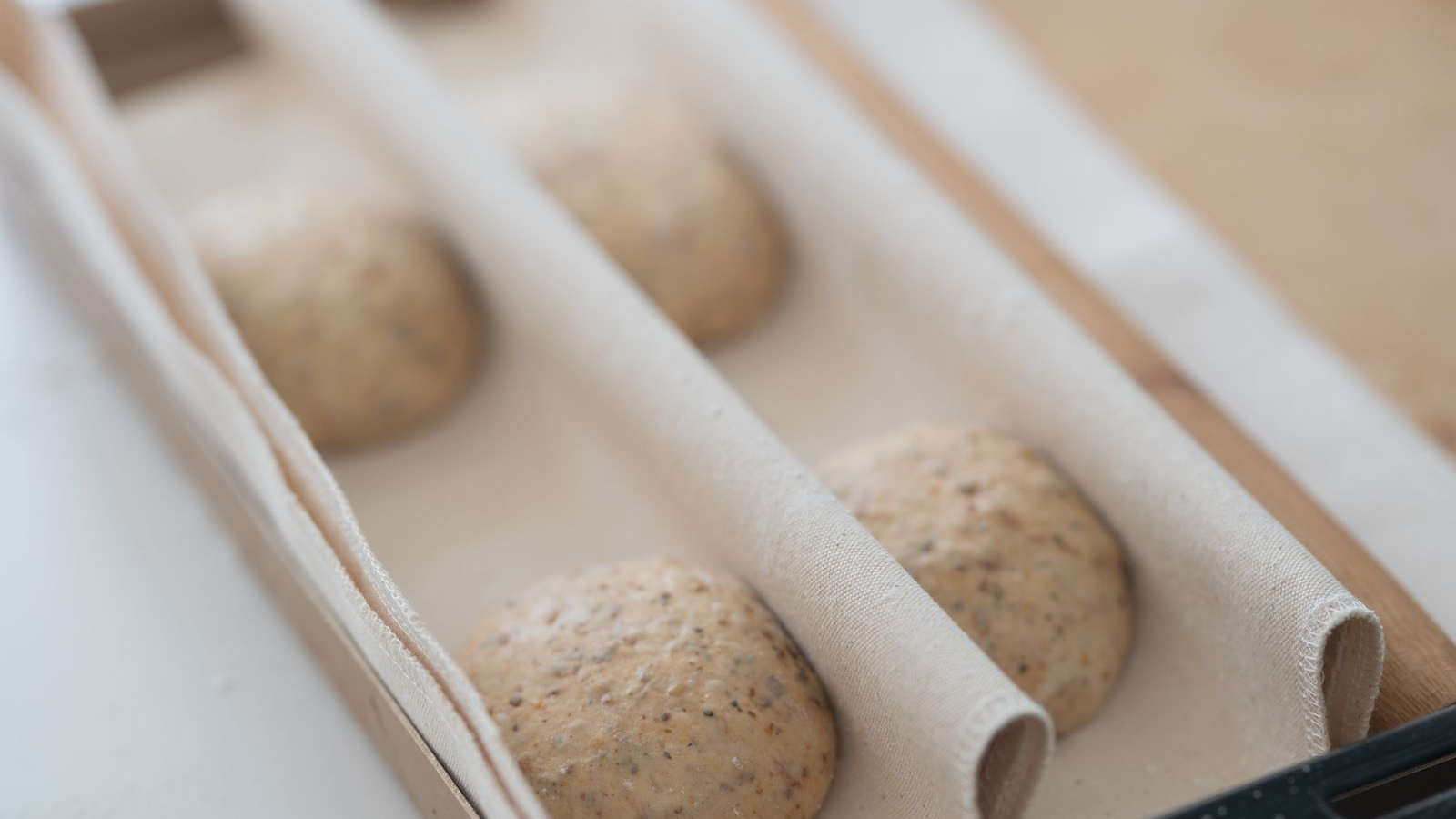
For bakery R&D, quality, and procurement teams evaluating a repeat-use mold inhibitor in packaged yeast bread.
Calcium propionate can reduce mold and rope spoilage in yeast-raised bread, but the familiar “0.1–0.3%” range is only a starting point. The useful dose depends on the bread’s pH, water activity, formula, microbial load, packaging, and local legal limit. It can also slow baker’s yeast under some conditions. A production trial should therefore measure two outcomes together: time or yeast required to reach the normal proof endpoint, and mold-free shelf life in the actual packaged loaf.
Quick Answer
Dose calcium propionate on flour weight, start at the lowest level that meets the shelf-life target, and confirm the legal limit for the destination market. Yeast performance can shift, so measure proof time and loaf volume rather than assuming the additive is inert. If mold still appears, diagnose the package, cooling and contamination pattern before increasing the dose, since a higher level may shorten proof without fixing the real failure.
The practical answer is to calculate the addition on flour weight, begin at the lowest lawful and technically plausible level, and compare it with an untreated control under the same process. Do not raise calcium propionate to compensate for poor sanitation or a post-bake contamination problem. A preservative is one hurdle in a system, not a substitute for clean cooling, slicing, and packaging.
What calcium propionate can—and cannot—solve
Calcium propionate (INS 282, often labeled E282) is the calcium salt of propionic acid. In bakery products it is used mainly to inhibit molds and rope-forming bacteria. The American Society of Baking describes it as a common preservative for yeast-raised products such as prepacked sliced bread and rolls, typically added during dough mixing. It also notes that activity is strongest below pH 5.5 and that the formula and desired shelf life influence the use level [1].
That pH point matters because propionate’s antifungal performance is not a fixed property of the powder alone. In a peer-reviewed study, Suhr and Nielsen tested bakery spoilage fungi across pH 4.7–7.4 and water activity 0.80–0.95. At 0.3% in the model system, calcium propionate inhibited many—but not all—fungi; efficacy varied with pH, water activity, and species [2]. The experiment was not a universal commercial bread validation. It shows why a supplier’s dose claim cannot predict your loaf’s shelf life without matching the product and process.
Calcium propionate does not prevent bread from becoming stale, correct a weak package seal, or remove mold spores introduced after baking. If spoilage is appearing on a particular slice face or package seam, investigate cooling-room air, slicer hygiene, handling, and packaging first. Increasing the preservative may mask a process defect while leaving its source in place.
Convert the percentage into a weighable batch addition
Bakery guidance commonly expresses calcium propionate as a percentage of flour weight, not total dough weight. The American Society of Baking lists 0.1–0.3% flour basis as a recommended bakery range [1]. Treat that as a screening range, not a universal formula instruction or a legal maximum.
Use this calculation:
Calcium propionate (kg) = flour in batch (kg) × target percentage ÷ 100
| Flour per batch | 0.10% | 0.20% | 0.30% |
|---|---|---|---|
| 25 kg | 25 g | 50 g | 75 g |
| 100 kg | 100 g | 200 g | 300 g |
| 500 kg | 500 g | 1.0 kg | 1.5 kg |
For example, a 100 kg flour batch at 0.20% requires 0.20 kg, or 200 g. If the formula contains multiple flour streams, define which ingredients count as “flour” in the plant’s calculation and keep that convention fixed across trials. Weigh the additive on a calibrated scale; teaspoon conversions are unsuitable for production because bulk density and particle form vary.
Before setting a trial target, check the finished-food limit in the destination market and product category. In the United States, 21 CFR §184.1221 affirms calcium propionate for specified food uses with no limitation other than current good manufacturing practice (GMP); this does not mean every country uses the same rule or that an arbitrary dose is acceptable [3]. EU conditions are category-specific. The Codex GSFA database is another reference point, but Codex provisions are not a substitute for national law [4]. Regulatory review should use the exact bread category, recipe basis, and jurisdiction.
Why proof time can change
Commercial baking references often say calcium propionate has little effect on yeast. That shorthand should not be read as “no effect in every formula.” In a study of selected antimicrobials at in-situ concentrations, calcium propionate produced the greatest reduction in baker’s yeast activity among the tested compounds [5]. A bakery trial reported by ingredient supplier TasteTech also adjusted yeast levels to reach a fixed 55-minute proof time; the amount of yeast needed changed across calcium propionate treatments [6]. The latter is supplier-generated application data, not independent evidence, but it illustrates a practical plant variable.
The yeast response may show up as slower dough expansion, longer proof, lower loaf volume at a fixed proof time, or a need to change yeast level. Those are not interchangeable outcomes. If the line proofs to a height or template, record the time to that endpoint. If it runs on a fixed timer, record dough height and baked volume as well. A change in yeast dose can restore throughput, but it also affects ingredient cost and may alter flavor or fermentation profile. Do not hide a proof penalty by reporting only mold-free days.
Mixing method and distribution matter. Calcium propionate should be dispersed consistently through the dough system; local high concentrations are undesirable. Follow the supplier’s handling and incorporation instructions, but validate them on the actual mixer and batch size. If the material is a powder, check dust control and whether dry blending with a portion of flour gives more consistent distribution. Do not add an unvalidated acidulant simply to push pH lower: acidity itself can change dough behavior, flavor, and yeast performance.
A compact trial that answers the production question
Run a controlled trial using the same flour lot, yeast lot, dough temperature, mixing energy, proof conditions, bake profile, cooling time, slicer, package, and storage conditions. Change only the preservative level in the first screen. A practical structure is an untreated control plus two or three lawful trial levels selected with your food-safety and regulatory teams. The purpose is not to prove a universal optimum; it is to identify whether the formula has a useful operating window.
For each treatment, make enough replicates to reflect normal line variability. Record:
- additive dose as percent of flour weight and grams per batch;
- dough pH, dough temperature, and water activity where available;
- yeast type and dose, mixing time, proof time, and proof endpoint;
- baked loaf weight, volume or height, crumb structure, and sensory notes;
- cooling, slicing, packaging, and storage conditions;
- visible mold or rope observations by day, package, and sample count.
Use the plant’s realistic storage temperature and package. Sliced bread may carry greater contamination risk than an unsliced loaf because slicing adds handling and exposed surfaces. TasteTech’s published white-bread trial, for example, used a defined formula at pH 5.3–5.5 and water activity 0.98, sliced and sealed 400 g loaves, held samples at 20°C, and inspected them daily. Its shelf-life numbers belong to those conditions; the authors explicitly caution that results vary with formulation, hygiene, packaging, and storage [6].
Define the endpoint before the bake. “Shelf life” may mean first visible mold, first failed package, a sensory limit, or a validated microbiological criterion; those are different measures. If challenge testing is needed, involve a qualified food microbiology laboratory and follow the site’s food-safety program. Do not deliberately inoculate production areas or rely on informal home-style observations for a commercial release decision.
A useful result is not simply “the 0.3% loaf lasted longest.” It is the lowest level that meets the defined spoilage target while keeping proof time, loaf volume, flavor, label, and cost within specification. If proof time rises sharply before shelf-life improves meaningfully, the formula may need a different hurdle strategy or a process correction rather than a higher calcium propionate dose.
Diagnose a failed trial before increasing the dose
If mold appears earlier than expected, compare the location and pattern across packages. A single mold spot near a cut surface suggests a different investigation from broad growth across multiple loaves. Review the preservative’s identity and dose records, lot COA, weighing checks, mixing uniformity, dough pH, package integrity, and sanitation records. Confirm that the observed defect is mold rather than rope spoilage or ordinary staling.
If proof slows but mold control improves, first verify the control dough’s fermentation and plant measurements. Compare yeast activity and lot age, dough temperature, proof humidity, flour changes, mixing conditions, and line timing. Then examine the lowest dose that met the microbiological target. Replacing yeast or increasing its dose can be a legitimate formulation choice, but it should be evaluated as a cost and quality trade-off, not assumed to be free.
Do not infer finished-bread performance from raw material purity alone. A calcium propionate assay or “99%” statement describes the ingredient’s chemical specification only to the extent that the method, basis, and lot documentation support it. It does not establish dose uniformity, mold resistance in your recipe, or the shelf life of your packaged bread.
Sourcing candidate for buyer review
The Alibaba listing linked below is a scale-up inquiry starting point for the preservative, not a statement that the grade suits your process. Verify the specification, sample and MOQ before locking a trial dose.
Qualify the ingredient for repeat orders
For an ongoing bakery program, ask the supplier for a current specification and lot-specific certificate of analysis. Confirm chemical identity (CAS 4075-81-4), assay method and basis, moisture or loss on drying, relevant contaminants, food-grade status for the intended market, packaging, shelf life, storage conditions, and traceability. Request representative samples from the intended production lot when possible. A generic certificate, catalog image, or marketplace badge does not verify the material that will arrive.
Check form as well as assay. Powder and granules can differ in handling, dust, dissolution or dispersion, and dosing equipment behavior. Confirm the particle form supplied is the one evaluated in the plant trial. For repeat purchasing, also agree how specification revisions, source changes, manufacturing-site changes, nonconforming lots, and complaints will be notified and handled.
Keep the investigation tied to the actual failure
Questions raised in baker forums and food-safety discussions tend to be practical: why does one loaf mold early, whether a preservative is slowing fermentation, and whether calcium propionate is the right control for the defect. Those threads help surface the language buyers use, but they are not controlled trials. A photo or a report that one formula “lasts two weeks” cannot identify the cause without the recipe, package, storage temperature, and contamination history.
For a repeatable plant investigation, separate three failure modes in the batch record: mold growth, rope spoilage, and staling. Mold and rope are microbial problems with different organisms; staling is principally a quality change. Record where the first defect appears, the lot and line, and whether nearby packages share the issue. This simple classification stops teams from increasing calcium propionate to solve a texture complaint or changing the preservative when the real issue is a contaminated slicer. It also makes supplier and plant trials comparable from one production week to the next.
The decision to take into the next bake
Calcium propionate is a reasonable candidate when the job is mold and rope control in yeast-raised bread and the product’s pH, process, and local regulations fit. The dosage figure alone cannot tell you whether it will preserve your bread or slow your line. Calculate on a defined flour basis, test at controlled levels, measure proof and loaf quality alongside mold-free time, and fix contamination routes before reaching for more preservative.
For procurement, buy against an agreed specification and verify each lot. For production, keep the lowest effective dose that passes the defined shelf-life target and line-quality limits. That turns a familiar commodity additive into a repeatable process input rather than a number copied from a supplier page.
References
- American Society of Baking. “Calcium Propionate.” https://asbe.org/article/calcium-propionate/ (accessed October 23, 2026).
- Suhr, K. I., and P. V. Nielsen. “Effect of weak acid preservatives on growth of bakery product spoilage fungi at different water activities and pH values.” International Journal of Food Microbiology 95 (2004): 67–78. https://pubmed.ncbi.nlm.nih.gov/15240076/.
- U.S. Food and Drug Administration. 21 CFR §184.1221, Calcium propionate. https://www.law.cornell.edu/cfr/text/21/184.1221.
- Codex Alimentarius. General Standard for Food Additives (GSFA), food category 07.1.1 and additive 282. https://www.fao.org/gsfaonline/ and https://www.fao.org/gsfaonline/additives/details.html?id=306.
- Stratford, M., et al. “Effect of selected natural antimicrobials on Baker’s yeast activity.” Letters in Applied Microbiology 33, no. 3 (2001): 211–215. https://pubmed.ncbi.nlm.nih.gov/11555206/.
- TasteTech. “A Guide to Using Encapsulated Sorbic Acid in Sliced White Bread.” Application study comparing treatments that included calcium propionate. https://www.tastetech.com/updates/category/study/ (accessed October 23, 2026). Supplier-generated data; test conditions and limitations are described in the source.
Related content
Continue exploring related ingredient research and sourcing guides.

Creatine Monohydrate 200 Mesh vs Micronized: What Buyers Should Verify
A 200-mesh claim and the word micronized are both shorthand. What each one can and cannot tell you, when sieve analysis is enough, and how to write a particle-size limit that a lot has to meet.
80 Mesh vs 200 Mesh Creatine Monohydrate: How Buyers Should Specify Particle Size
Mesh is a sieve shorthand, not a specification. How to make 80 and 200 mesh comparable, test dispersion at the intended dose, and write a particle-size limit into the RFQ.

L-Carnitine L-Tartrate COA: How to Read a 99% Assay and a 68% L-Carnitine Result
A salt assay near 99% and an L-carnitine result near 68% can describe the same pure material. How to name the analyte, the basis and the method so a COA actually releases a lot.

L-Theanine COA Checklist for Ingredient Buyers
A 98% HPLC result is only the headline. How to tie the L-theanine COA to a lot, read the assay basis, and keep L-form evidence separate from a routine non-chiral assay.